No hot water, leaks and strange noises: what each one means
Most water heater calls start with a symptom, not a part name. The symptom narrows the list of causes quickly, and some causes are cheap to fix while others mean the tank is finished.
No hot water at all
On an electric tank this is often a failed heating element or a tripped thermal cutoff. On gas it is usually the pilot assembly, thermocouple or gas control valve.
Lukewarm water
A burned-out lower element, a broken dip tube mixing cold water in, or a thermostat set too low.
Rumbling or popping
Sediment baked onto the bottom of the tank. Flushing helps early. Heavy buildup often means the tank is near the end of its life.
Water around the base
A loose fitting or relief valve can be fixed. A leak through the tank shell cannot, and the heater needs replacing.
What to check before we arrive
- Look for water on the floor and trace it to a fitting, the relief valve pipe or the tank bottom.
- Confirm the breaker has not tripped, or that the gas shutoff is open and the pilot is lit if your model has one.
- Do not touch wiring or relight a pilot if you smell gas. Leave the house and call the gas utility or 911 first.
- Note the age on the data plate. Tanks past about 10 years are often better replaced than repaired.
Gas, electric, hybrid and tankless: how repairs differ
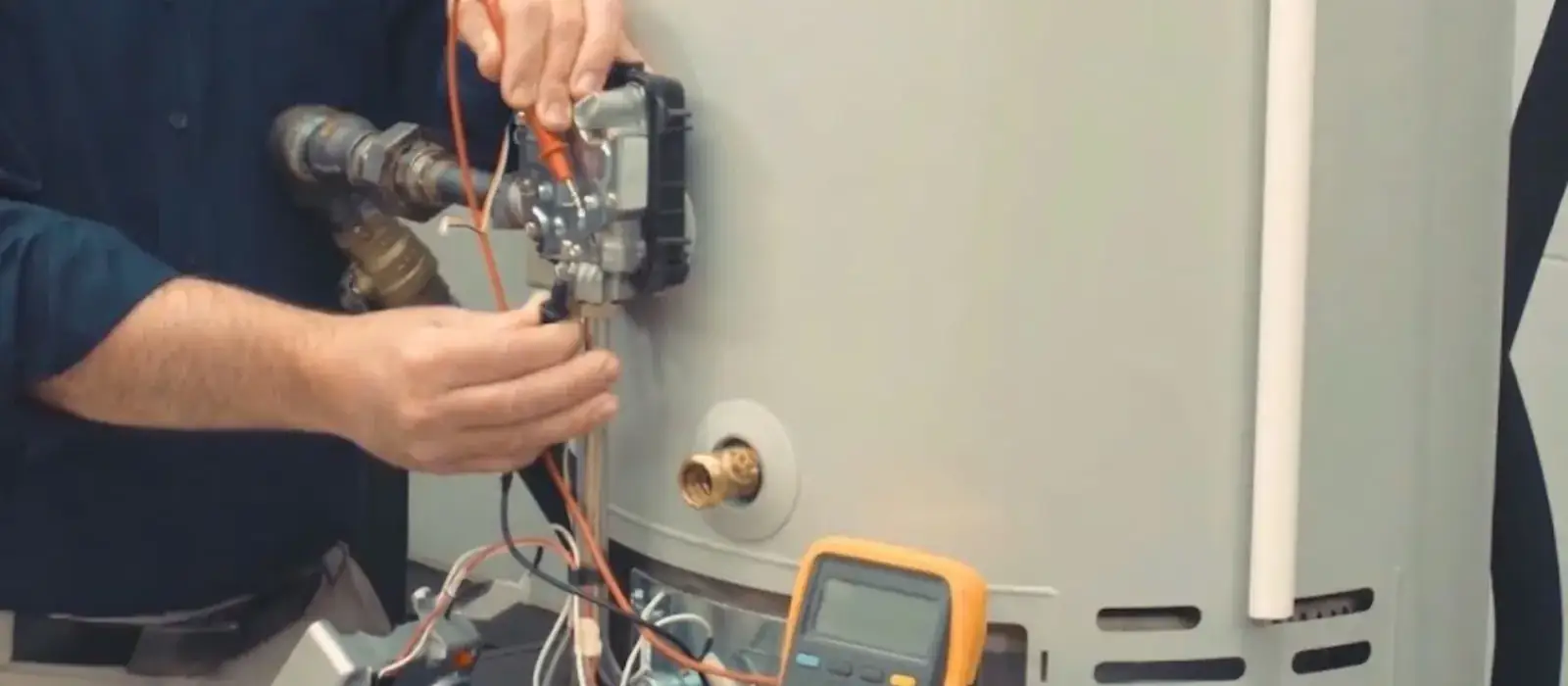
A gas heater has a burner, a flue and a gas valve, so repairs involve combustion safety as well as plumbing. An electric tank has two elements and two thermostats, and testing them with a meter takes minutes. A heat pump hybrid adds a compressor and a condensate line. Tankless units add flow sensors, igniters and a scale-prone heat exchanger.
Parts differ, but the first step is the same. We test before replacing anything, and we show you the failed part. If you are weighing a repair against a new unit, our water heater replacement page lays out the numbers, and the tankless water heater page covers flushing and descaling.
| Situation | Usually repair | Usually replace |
|---|---|---|
| Tank age | Under about 8 years | Past about 10 to 12 years. |
| Leak location | Fitting, valve or pipe | Tank shell or bottom seam. |
| Heating | Single failed element or thermostat | Repeated failures in one year. |
| Tank interior | Light sediment | Rust in the hot water or heavy scale. |
Howell water and your water heater
Howell note: what the local water report shows
New Jersey American Water's 2025 report for its Coastal North system lists Howell as a sampling location. It shows total hardness of 72 to 140 mg/L as calcium carbonate over 2023 to 2025. That is roughly 4 to 8 grains per gallon, moderate hardness, so scale builds up more slowly than in very hard water areas but it still builds.
The practical result is that flushing a tank once a year and checking the anode rod are worth doing, and a heater that sounds like popping corn has probably gathered sediment. If your home runs on a private well, hardness can be very different. Test your tap water or ask a lab for a hardness reading before you buy a softener or pick a heater.
No hot water today?
Call now and a Howell plumber can look at the heater.
What affects the price of a water heater repair
A repair price depends on the part and the access, not on a flat rate.
Insurance usually pays for water damage from a sudden tank failure but not for the heater itself or for wear and tear. Photograph the area before cleanup.
For a firm number, call (732) 466-1098 and give us the make and age.
Gas heater safety comes first
A gas water heater needs a clear flue and enough combustion air. Soot streaks above the draft hood, a pilot that keeps going out, or a yellow flame all point to venting or burner trouble. Do not ignore a carbon monoxide alarm. Open windows, leave the house and call 911 or your gas utility before you call a plumber.
Where the heater is original to an older house, we also check the relief valve, the discharge pipe and the supply connections. These are the small parts that fail quietly and cause the large leaks. If a heater has to be moved or re-vented, the work is closer to a new water heater installation than a repair.
Standards behind the safety parts
A tank heater should carry a temperature and pressure relief valve with a discharge pipe. New Jersey adopts the 2021 National Standard Plumbing Code as its plumbing subcode in N.J.A.C. 5:23-3.15, and it governs how that pipe is run. The CDC also advises having a gas or oil water heater serviced by a qualified technician every year.
Questions homeowners ask
Yes. A failed heater or an active leak is handled around the clock. Call the Howell line, tell us if water is leaking, and we will advise you to shut off the supply and power while a plumber heads your way.
Often yes. We carry common elements, thermostats, relief valves and thermocouples on the truck, so many repairs are finished during the first visit.
Sediment collects at the bottom of the tank and traps water that boils under it. Flushing may reduce it, but heavy buildup usually returns and can shorten the tank life.
A small leak at a fitting is a repair. A leak from the tank body means failure, and the heater should be shut off and drained. Never ignore water near electrical parts.
Yes. We diagnose error codes, igniters, sensors and scale. If the manufacturer part is no longer available or the heat exchanger has failed, we explain the replacement choices.
A typical tank lasts about 10 to 15 years. Hard water, a missing anode rod and no flushing all shorten that range.