Signs your pipes may need replacement
Common warning signs
- Repeated pinhole leaks in copper or leaks at fittings.
- Brown, orange or cloudy water, especially after the water sits.
- Low pressure that is worse on upper floors.
- Visible green or white corrosion at pipe joints.
- Galvanized steel pipe, which corrodes from the inside.
- Pipe that rattles, hammers or sweats badly.
A plumber can often see the pattern from a few exposed pipes. When we find the pipe type, the age and the leak history, we can tell you whether a single run needs replacement or the whole system does.
PEX, copper and CPVC compared
| Material | Strengths | Trade offs |
|---|---|---|
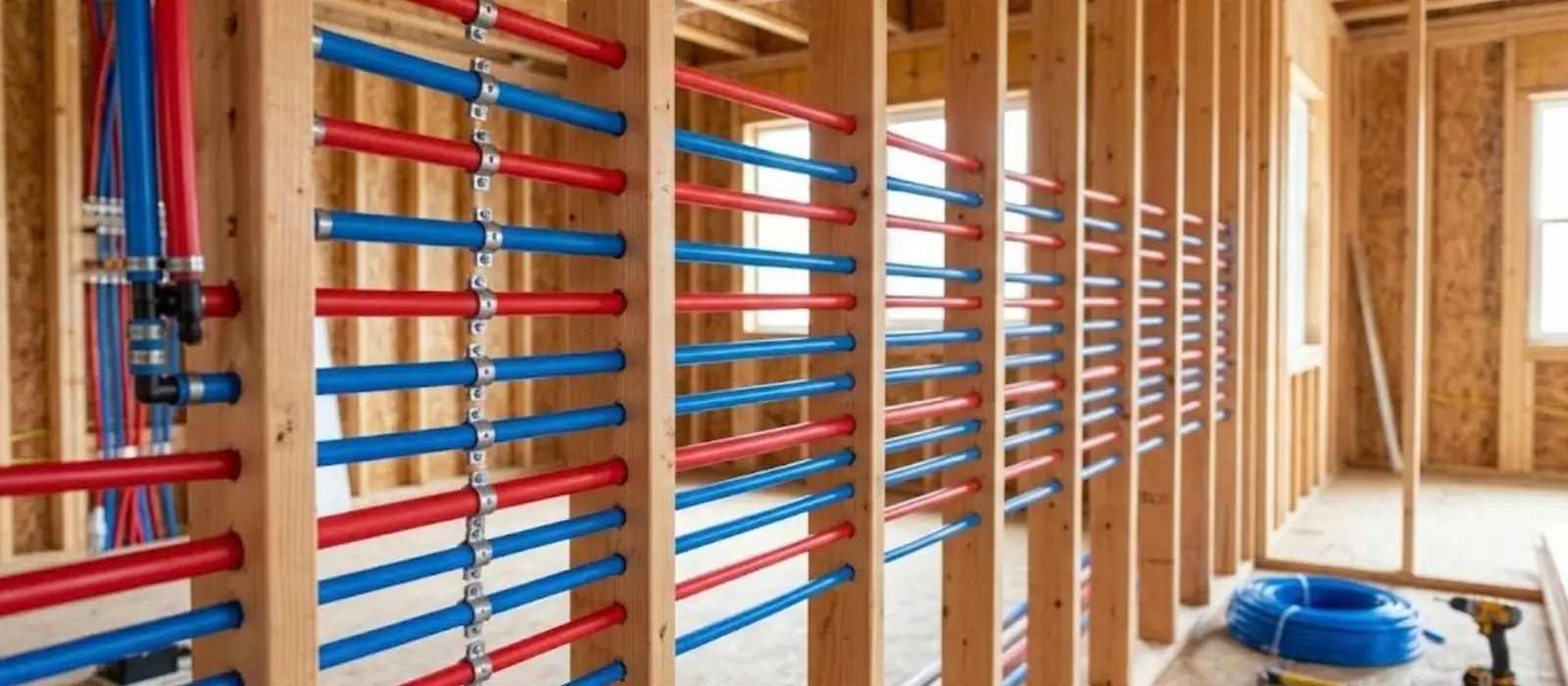
| PEX | Flexible, fewer fittings, quicker to install, tolerant of freezing | Not for sunlight exposure, needs proper support and fittings. |
| Copper | Long track record, rigid and durable | Higher material cost, can pit in aggressive water. |
| CPVC | Lower cost, resists corrosion | More brittle, more fittings, less tolerant of heat and stress. |
There is no single best choice for every house. We look at your water, your layout and your budget, and we tell you the trade offs. We do not choose a material because it is cheaper for us. We choose it because it fits the house.
Whole house or partial repipe
A partial repipe replaces a bad run, such as the lines under a bathroom or the main branch to a kitchen. It costs less and takes less time. A whole house repipe replaces everything and ends the pattern of leaks. If one section is bad and the rest is in good shape, partial is often enough. If the pipes are all the same age and failing, a whole house repipe saves repeated repairs.
Inspect
We look at the pipe type, age, leak history and access.
Plan
We outline a partial or whole house plan and a clear price.
Replace
We run new lines, usually through walls and ceilings with small access openings.
Test and patch
We pressure test the system and leave the work clean. Drywall repair is discussed beforehand.
What happens to your walls and your water
Repiping needs access, but modern methods rely on small openings and fishing lines through framing where possible. We shut off water for a limited time each day when we can, and tell you when it is off. We plan around bathrooms and kitchens so you can still live in the house when the project allows.
Howell note: water quality and pipe life
New Jersey American Water's 2025 Coastal North report, which lists Howell as a distribution sampling location, shows total hardness of 72 to 140 mg/L. Moderate hardness leaves scale inside older pipe and fixtures, and the water's chemistry affects how copper and steel age. Homes on private wells have different water, sometimes with iron or acidity, and those conditions change which material is a better fit.
If you are on a well, a water test helps us advise on material. Permits apply to most repipe work, and the township Construction Office, at the municipal building on Preventorium Road, can tell you what is needed. We take care of the permit process when the job requires it.
Pipes leaking again?
Call the Howell line to schedule a repipe look and a clear price.
What affects repiping pricing
Repiping is a larger project, so we quote after we see the house.
Insurance rarely pays to replace aging pipe. A sudden failure that damages the home may be covered, and a policy may require evidence of the leak. Keep photos and call your agent.
Call (732) 466-1098 to schedule a visit.
If one leak is the issue, see leak detection or burst pipe repair. If the problem is in the line from the street, our water service line repair page covers it.
Tubing standards to look for
PEX tubing for water supply is made to ASTM F876, and parts that touch drinking water carry the NSF/ANSI 61 mark. Ask your contractor to show you the printed markings on the tubing and fittings. New Jersey adopts the 2021 National Standard Plumbing Code as its plumbing subcode in N.J.A.C. 5:23-3.15.
Questions homeowners ask
Repeated leaks, discolored water, low pressure and old galvanized or failing copper pipe are the main signs.
A partial repipe can take a day or two. A whole house repipe may take several days, depending on the house.
No. We shut water off for part of each day and tell you when it will be off.
Each has strengths. PEX is flexible and quick to install. Copper has a longer track record. The right pick depends on your house and water.
Most repipe jobs need one. We handle the process when it applies.