
Why a boiler stops heating
| Symptom | Likely cause | Typical fix |
|---|---|---|
| No heat at all | No power, no fuel, tripped safety or ignition failure | Check supply and safeties, then repair the failed part. |
| Radiators cold at the top | Air in the system | Bleed the radiators and check the fill. |
| Pressure drops or rises | Leak, failed expansion tank or faulty fill valve | Repair the leak or replace the part. |
| Banging or kettle noises | Scale, low water or a failing pump | Flush the boiler or replace the pump. |
| Turns on and off quickly | Oversized unit, thermostat or flame sensor problem | Clean sensors, adjust controls. |
| Water around the boiler | Leaking valve, fitting or heat exchanger | Repair or replace depending on the source. |
Safe checks before you call
- Make sure the thermostat is set to heat and has fresh batteries.
- Check that the boiler has power and the switch is on.
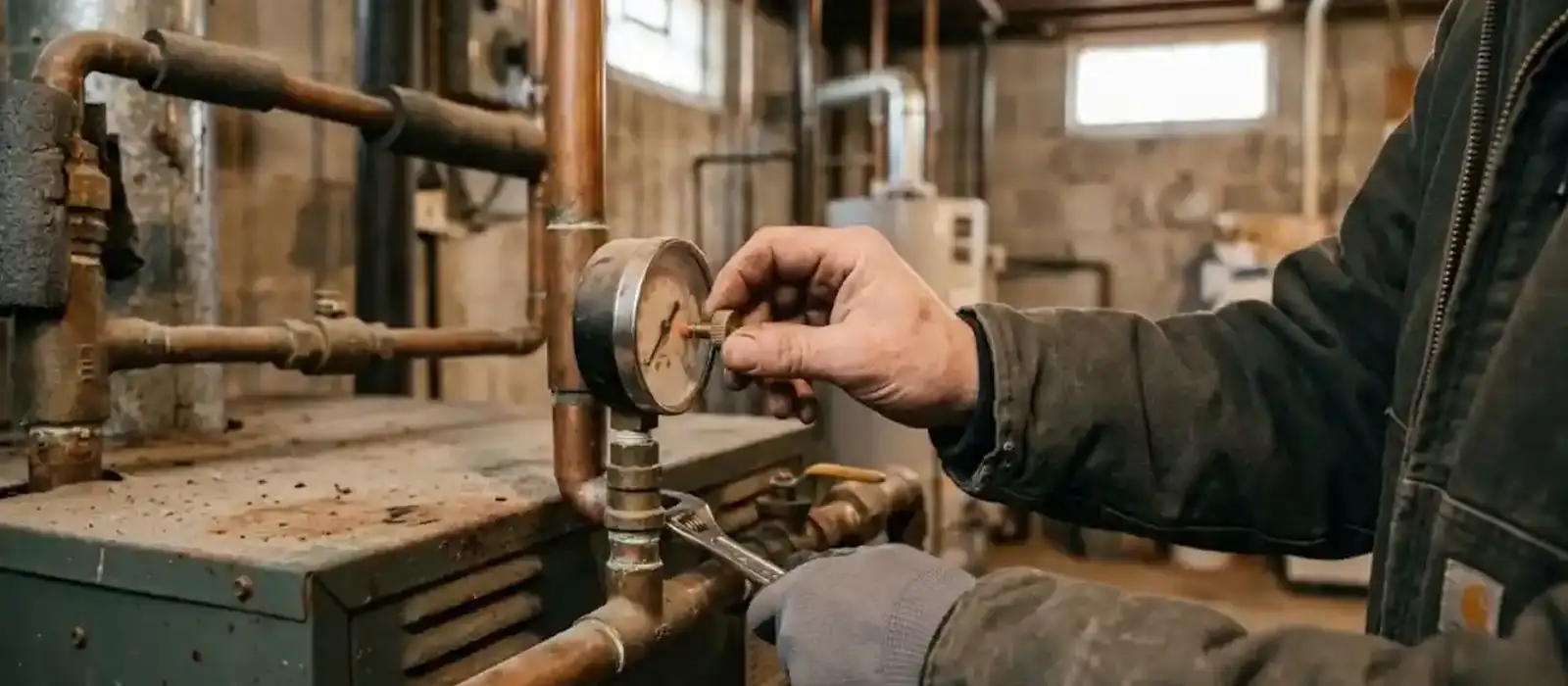
- Look at the pressure gauge, which usually sits between 12 and 15 psi when cold, but follow your manual.
- Check that the fuel supply is on, and that oil tanks are not empty.
- Do not open the boiler cabinet or bleed gas lines yourself.
- If you smell gas, leave and call the gas utility.
Gas and oil boilers
Gas boilers use burners, ignition parts and a vent. Oil boilers use a burner, a nozzle and a fuel pump, and they need regular cleaning. Both have safety controls that shut the boiler down when something is wrong. A shutdown is the boiler protecting the house, and we find what triggered it before we restart it. If it needs an oil burner service or fuel work, we tell you early if another trade should handle that part.
Repair or replace
An older boiler with a cracked heat exchanger, repeated leaks or parts that are no longer made is not worth repairing again and again. We explain the trade offs in plain terms, including the cost of a repair against the age of the unit. If replacement is the answer, we describe the options and a clear price, and we cover the work that falls under plumbing installation such as new valves and piping.
Safety check
We check for gas or fuel odors, carbon monoxide risk and leaks.
Diagnose
We look at controls, pressure, flame, circulation and venting.
Repair
We replace the failed part or flush and clean the system.
Test
We run a full heating cycle and confirm every zone gets heat.
Howell note: fuel and seasonal timing
Howell homes heat with a mix of fuels and systems depending on age and street, so tell us whether your boiler runs on natural gas, oil or propane. A gas boiler depends on a working gas supply, and an oil boiler depends on a filled tank and a clean burner.
Cold snaps bring a rush of calls, and parts get hard to find. If your boiler is old, have it checked in early fall, before the first cold week. Carbon monoxide alarms should be present near sleeping areas, and replace the batteries each year. Permits may apply to a boiler replacement, and the township Construction Office, at the municipal building on Preventorium Road, can tell you what applies.
No heat tonight?
Call the Howell line and tell us your fuel type.
What affects boiler repair pricing
A small part and a major component are very different repairs.
Insurance does not usually cover worn boiler parts. A sudden failure that causes water damage may be covered, so photograph it and call your agent.
Call (732) 466-1098 for a clear price.
If your hot water comes from a tank, see water heater repair. If a leak is the problem, our leak detection team can help find it.
Carbon monoxide and annual service
According to the CDC, you should install battery operated or battery backup carbon monoxide detectors near every sleeping area and have heating systems, water heaters and other gas or oil burning appliances serviced by a qualified technician every year. The CDC also suggests replacing detectors every five years or per the maker.
Questions homeowners ask
Yes. A boiler failure in cold weather is an emergency and we answer around the clock. Call the Howell line, tell us your fuel type and any error code, and we send a plumber as soon as one is available. If you smell gas, leave the house and call the gas utility or 911 first.
It could be a thermostat, power, fuel, ignition or pressure problem. We check each before replacing parts.
A small drip can wait for a visit, but a steady leak or a gas smell cannot. Shut it off and call.
Most residential boilers sit in a low range when cold, but follow your manual. Pressure that keeps rising or falling points to a problem.
We handle the plumbing and boiler side. For burner and fuel tank work we tell you early if another trade is needed.
If it is old, leaking or needs a major part, replacement may make more sense. We give you the numbers and let you decide.