Flush and descale: the service most owners miss
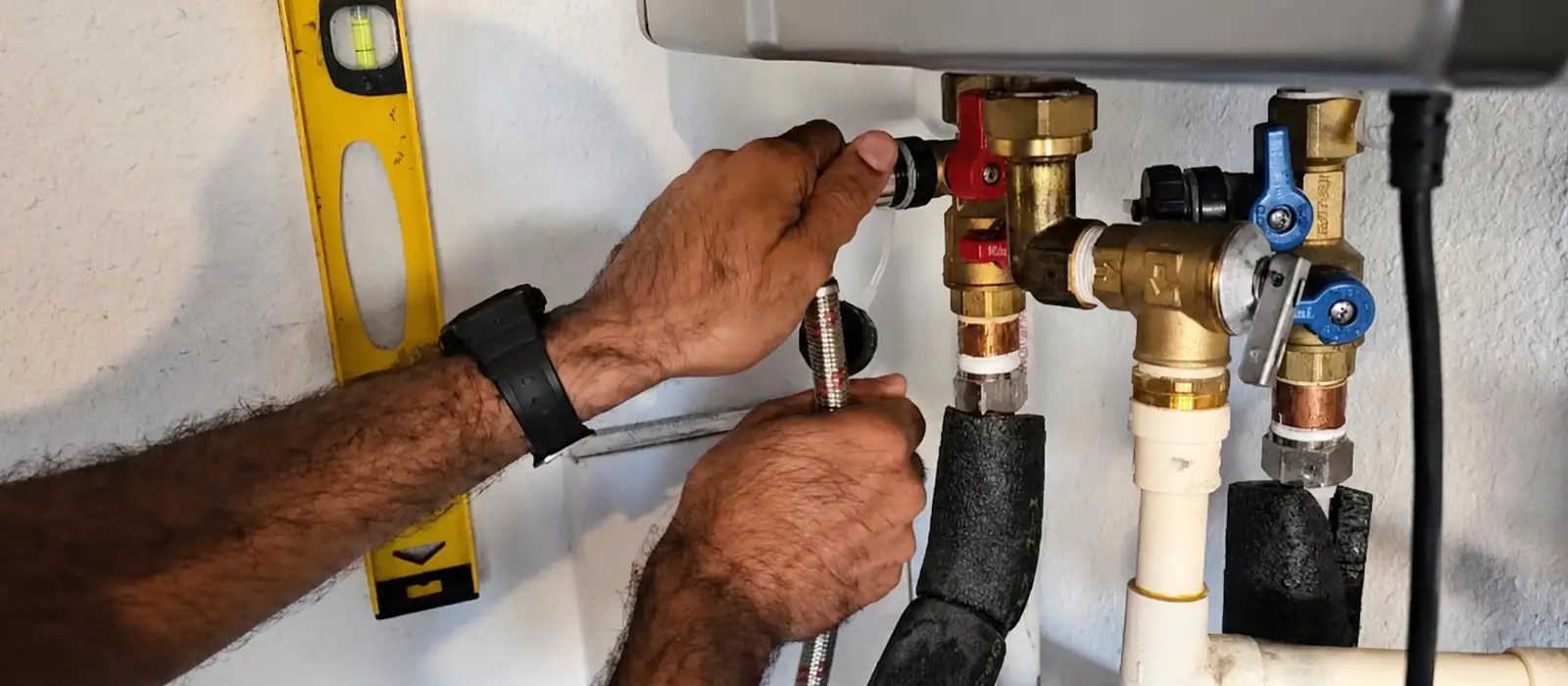
Scale is the main enemy of a tankless heater. Minerals in the water bake onto the heat exchanger and narrow its passages. The unit then works harder, throws error codes, cycles between hot and cold, or shuts down. Descaling dissolves that buildup with a circulating solution, and the unit is flushed clean before it returns to service.
Signs your tankless heater needs a flush
- Water temperature swings between hot and lukewarm.
- An error code about flow, ignition or exhaust temperature.
- Longer wait for hot water than the unit used to give.
- It has been more than a year since the last service, or the maker recommends a shorter interval.
A mild vinegar flush from a hardware store works for some owners, but it is slow, it does not reach every passage, and it can be hard to do right if the isolation valves were never installed. We install valves on units that lack them so the flush is quick and repeatable.
Condensing and non condensing units
A condensing tankless heater has a second heat exchanger that captures heat from the exhaust. It runs more efficiently, vents through plastic pipe, and produces acidic condensate that must drain to a neutralizer. A non condensing unit vents through stainless steel, costs less up front and runs slightly less efficiently. Our blog guide explains the trade in detail for Howell homes.
| Feature | Condensing | Non condensing |
|---|---|---|
| Venting | PVC or similar plastic, can run through a side wall | Stainless steel, often larger and costlier. |
| Condensate drain | Required, with a neutralizer | Not required. |
| Efficiency | Higher | Slightly lower. |
| Up front cost | Usually higher | Usually lower. |
Installing a tankless heater in an older house
Many homes were built for a tank. Replacing it with a tankless unit changes the demands on the house. The gas line may be too small for a high input burner. The old flue may not suit the new vent. An electric unit may ask for far more current than the panel can spare. We check all three before quoting, and we say so when a tank is the better fit.
Survey
We check gas line size, vent route, electrical capacity and where the unit will mount.
Size
We match gallons per minute to the fixtures you run at once.
Install
We mount the unit, add isolation valves, vent it, connect gas or power and set up condensate.
Teach
We show you the controls, the filter and the flush schedule.
Howell note: water quality and scale
New Jersey American Water's 2025 Coastal North report, which lists Howell as a distribution sampling location, shows total hardness of 72 to 140 mg/L. That is about 4 to 8 grains per gallon. Moderate hardness still leaves scale on a heat exchanger over time, and hotter outlet settings speed it up.
If your house uses a private well, test the water because hardness, iron and sediment vary widely and can clog a tankless unit faster. Our water heater repair team can check the unit once you know what is in the water.
Need a tankless service visit?
Call to book a flush, a repair or an install quote.
What affects tankless pricing
Three jobs fall under this page, and each has its own drivers.
Insurance does not usually cover tankless maintenance or wear. A sudden leak that damages a home may be covered, so call your agent after you stop the water.
Call (732) 466-1098 with the make and model for a price.
If your tankless heater has failed outright and you need hot water today, our water heater replacement page explains how we handle failed units.
Manufacturer rules and the state code
A gas tankless unit must be vented with the pipe material its maker lists, and the manual is part of the installation requirements. New Jersey adopts the 2021 National Standard Plumbing Code as its plumbing subcode in N.J.A.C. 5:23-3.15. The CDC advises annual service by a qualified technician for water heaters that burn gas or oil.
Questions homeowners ask
Follow the manufacturer, which is usually once a year. Hard water or heavy use can justify a shorter interval.
Yes. We service the common gas and electric brands, and we tell you honestly if a part is unavailable.
Codes usually point to ignition, flow, venting or temperature. We read the code, check for scale and venting problems, and fix the cause rather than clearing the code.
Not always. It saves standby heat loss, but the unit costs more to install, and scale or poor sizing can erase the savings.
Yes, but have the water tested first. Iron, sediment and hardness change the maintenance plan and sometimes call for a filter.