Why flushing matters
Minerals in water leave a scale on the walls of the heat exchanger. A thin layer insulates the metal, so the unit has to work harder to heat the same water. Thicker scale narrows the passages and triggers error codes, temperature swings and shutdowns. A flush dissolves that scale with a mild acid, then rinses it out.
Tools and supplies
- A small submersible pump, rated for the job.
- Two lengths of hose with fittings that suit your service valves.
- A bucket large enough to hold a few gallons.
- Descaling solution from the maker, or food grade white vinegar.
- Gloves and eye protection.
- A copy of your manual for the maker steps.
Check the manual first. Some makers call for a specific solution and a specific time, and using the wrong product can damage the unit or void the warranty. If you have a condensing heater, you may need to check the neutralizer at the same time. Our guide on tankless water heater service explains what a full visit includes.
The flush step by step
Power off and shut the water
Turn off the electric or the gas, close the cold and hot isolation valves and the gas valve.
Connect the hoses
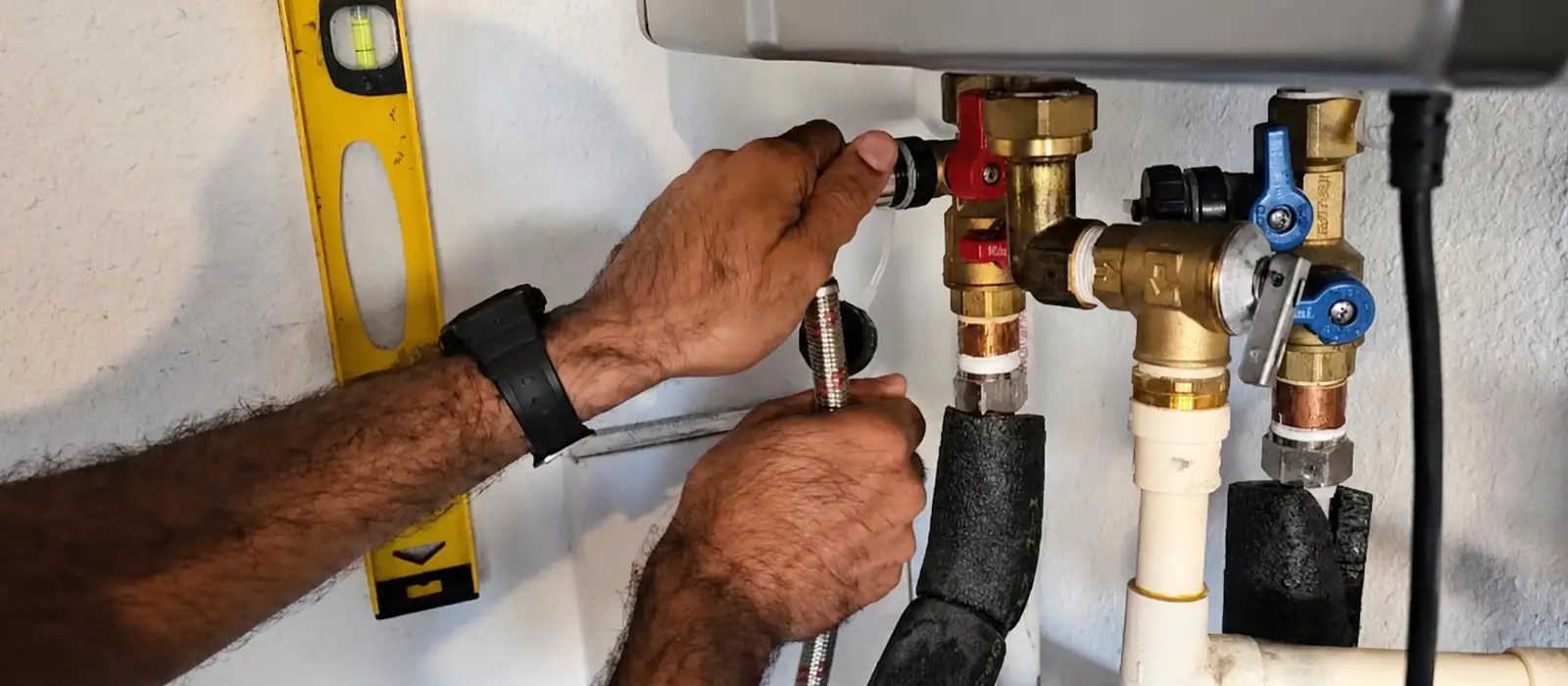
Attach one hose from the pump to the cold service valve and another from the hot service valve back to the bucket.
Circulate the solution
Pour the solution into the bucket, open the service valves and run the pump for the time the maker recommends, often about an hour.
Rinse and restart
Drain the solution, flush with clean water, remove the hoses, check the inlet screen, reopen the valves and restart the unit.
| Problem | Likely cause | Fix |
|---|---|---|
| No service valves | Unit was installed without them | Have a plumber add isolation valves. |
| Hoses leak | Wrong fittings or washers | Use the right fittings and new washers. |
| Unit shows an error code after the flush | Air in the lines or closed valve | Bleed air and reopen all valves. |
| Water still lukewarm | Heavy scale, clogged filter or other fault | Repeat the flush and check the inlet screen. |
| Smell of vinegar in the water | Insufficient rinse | Run hot water through every tap for several minutes. |
Clean the inlet filter
Many tankless units have a small screen on the cold inlet that catches sediment. A blocked screen cuts flow and causes odd temperatures. Remove it, rinse it and put it back with a good seal. Do this each time you flush, and more often if you are on well water.
When to stop and call a plumber
If the unit has no service valves, if a valve is stuck, if you smell gas or if error codes return after a flush, stop. Forcing a valve can crack a pipe, and a gas smell means you should leave the house and call the gas utility or 911 before anything else.
How often to flush
Once a year is the common recommendation, but the real answer depends on your water and your use. A large household that uses a lot of hot water will build scale faster. A house on a private well with high minerals may need more frequent service. If the unit begins to show reduced flow, longer waits for hot water or error codes, that is a sign to flush sooner.
How to tell the flush worked
After the flush, run hot water at a tap and watch the temperature. It should reach the set point quickly and stay steady while you run it. Error codes should clear and stay clear.
If you can see the old solution, it should be cloudy or tinted with scale, and the rinse water should run clear by the end. A unit that still struggles may have scale in places the flush did not reach, or a different fault, and a second look is warranted.
Write the date of the flush on the unit or in your calendar, and set a reminder for the next one so the job does not slip a year or two.
Keep the manual and the model number where you can find them. If the unit is under warranty, the maker may ask for proof of annual service, and a dated note or receipt for each flush is exactly that proof.
Howell note: water hardness and the flush schedule
New Jersey American Water's 2025 Coastal North report lists Howell as a distribution sampling location, and total hardness in that report runs from 72 to 140 mg/L. That is moderate, but the hot end of a tankless heat exchanger concentrates it, so a yearly flush is a sensible default for city water customers.
If you are on a well, test the tap. The numbers may be higher, and iron or sediment will clog the inlet screen quickly. If you want us to handle the flush and add service valves, call, and see our water heater installation page for how we install and size a new unit. We also serve Lakewood and nearby towns.
Sources
Flush steps and approved solutions come from the manufacturer's manual. According to the CDC, water heaters that burn gas or oil should be serviced by a qualified technician every year.
Rather have a plumber look at it?
Call the Howell line, any hour, and describe what you see.
Questions about this topic
Many makers allow white vinegar, but some prefer their own solution. Check your manual before you start.
Often about an hour with a pump, but the maker may recommend a different time. Follow the manual.
Yes, to do it properly. Without them, a plumber can add valves so the flush is quick and repeatable.
Air in the lines, a closed valve or leftover scale are common causes. Bleed air, check every valve and run the unit again.
For most city water customers it is a good default. Well customers should test the water and may need more frequent service.