
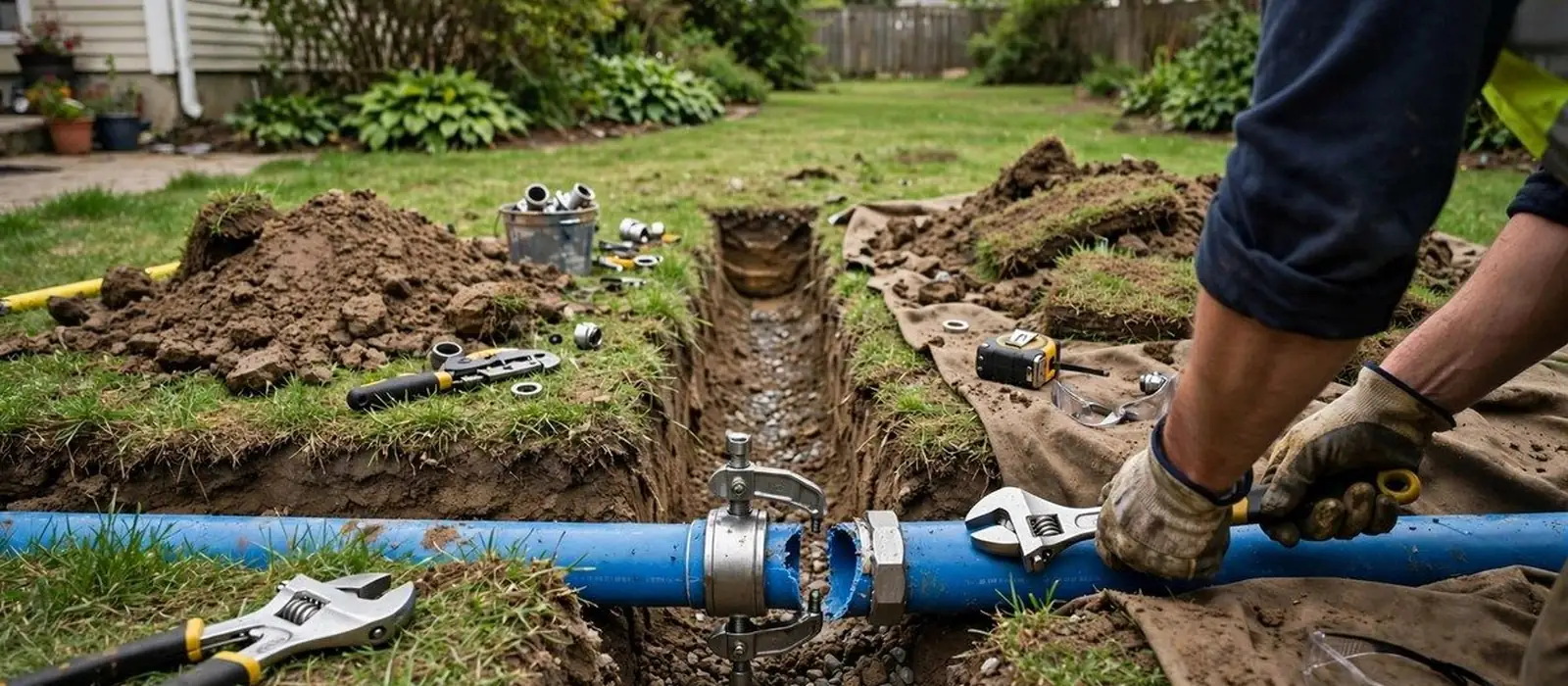
Signs of a service line problem
What homeowners notice
- Water meter keeps moving when every tap is off.
- A wet, soft or unusually green patch in the yard.
- Sudden drop in pressure at every fixture.
- Dirty or cloudy water after a repair or a break.
- The sound of running water outside or near the meter.
- A water bill that rises with no change in use.
Check whether the leak is on the street side or the house side of the meter. The utility usually handles its own side up to and including the meter. The pipe from the meter to the house is generally the homeowner's, but boundaries vary, so confirm with the utility.
Repair methods for buried lines
| Method | Best when | Trade off |
|---|---|---|
| Spot dig repair | A single failed section, shallow line | Digs a trench in the yard. |
| Trenchless replacement | Longer failed run, valuable landscaping | Needs access pits, not always possible. |
| Full replacement | Old galvanized or failed pipe along the whole run | Highest cost, longest job. |
| Reroute | Line passes under a structure or a large tree | New path needs approval and may cost more. |
We choose the method after we locate the leak. Old galvanized steel and lead lines should not be patched when replacing the run is the better choice. If we find material that could contain lead, we tell you plainly and discuss replacement and testing.
How we find a buried leak
We confirm the meter movement, isolate the line with a pressure test and use acoustic listening and line tracing to pinpoint the break. We mark the spot, show you the location and agree on the repair before any digging. We try to keep the dig small and the yard restorable.
Confirm
We check the meter, the main valve and the house side to be sure the line is the issue.
Locate
We pinpoint the leak and depth with listening gear and line tracing.
Repair
We dig, replace or reroute and use fittings suited to the pipe.
Test and flush
We pressure test, flush the line and restore water, and we explain yard restoration.
Howell note: utility side, well side and permits
In municipal water areas of Howell, New Jersey American Water's Coastal North system supplies water, and the utility maintains the main in the street and its connection. The service line on your property is a separate matter, and the utility can tell you where its responsibility ends.
Many Howell properties rely on private wells instead of a service line from the street, and their water line runs from the pressure tank or well to the house. In either case, call before you dig, and the township Construction Office, at the municipal building on Preventorium Road, can tell you if a permit applies. New Jersey requires a mark out request before excavation, and we handle that process before any dig.
Pressure gone or yard soaked?
Call the Howell line and we will find the leak.
What affects the cost of service line repair
Cost depends on length, depth and what sits on top of the pipe.
A policy may cover water damage and sometimes a service line endorsement exists. Many policies exclude the line itself. Ask your agent and keep a record of the leak.
Call (732) 466-1098 for a visit and a clear price.
Related work includes leak detection for finding where water is leaving the system, and repiping when the lines inside the house are failing too.
The lead law behind line replacement
A 2021 New Jersey law requires water providers to identify and replace lead and galvanized steel service lines by 2031, according to New Jersey American Water. Before any dig, call New Jersey 811, the state's one call system, so buried utilities are marked. We handle that call.
Questions homeowners ask
Yes. A broken service line is an emergency and we answer around the clock. If the water is flowing out in the yard, close the main valve inside the house and call the Howell line.
Usually the utility handles the street main and the meter. The pipe from the meter to the house is generally the homeowner. Confirm with your utility.
If the meter moves with all fixtures off and the main valve in the house is closed, the leak is outside the house.
Yes. We explain the options and recommend replacement when the line is old or made of a material that raises concerns.
No. We locate the leak first and dig only what the repair needs. Trenchless methods may reduce digging.
A well has a line between the pressure tank or pump and the house. We repair those lines too.