
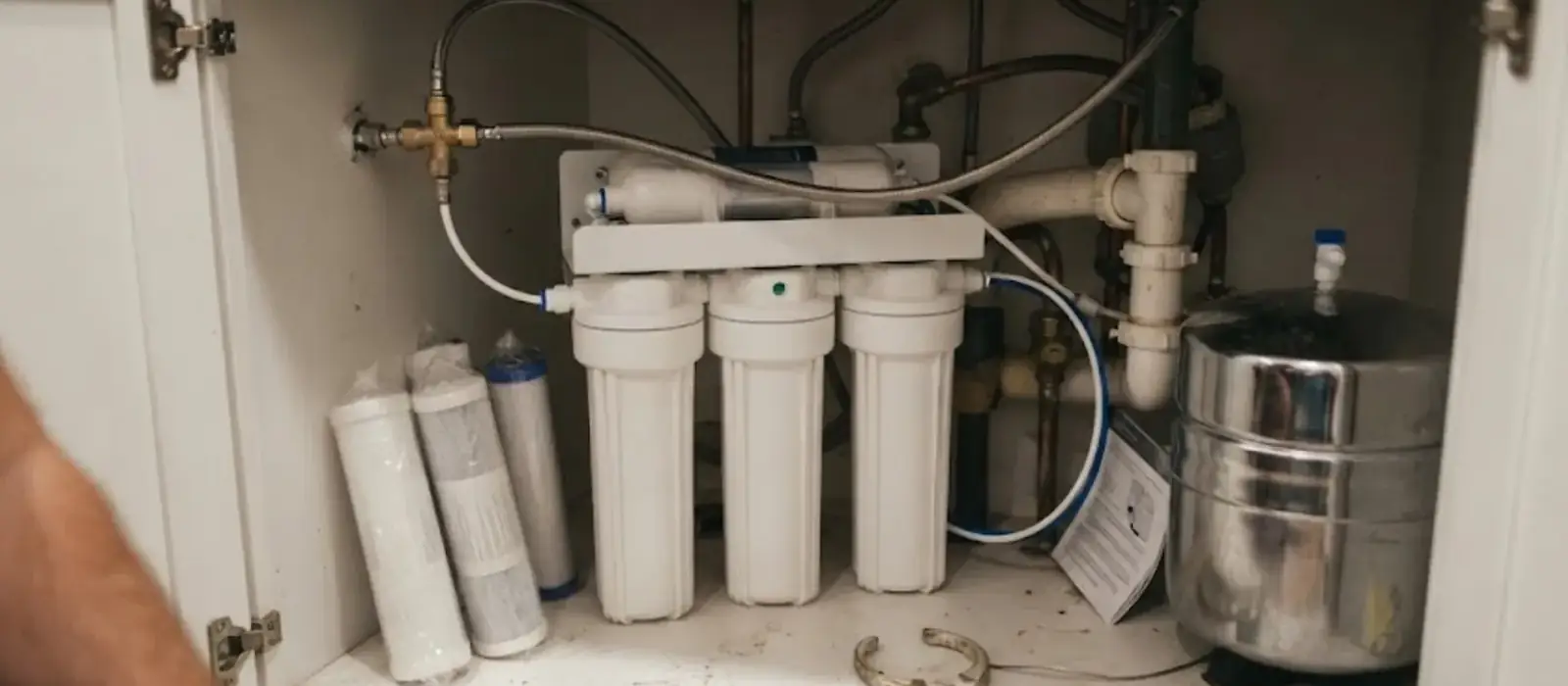
The main parts of a filter system
| Part | What it does | When it needs attention |
|---|---|---|
| Sediment filter | Catches sand, rust and silt | Replace on schedule or when pressure drops. |
| Carbon filter | Reduces taste, odor and some chemicals | Replace by the maker interval. |
| Housing | Holds the cartridge under pressure | Check for cracks and leaks. |
| O ring or gasket | Seals the housing | Replace when you open the housing, if worn. |
| Bypass and shutoff valves | Isolate the system for service | Test that they turn. |
| Pressure gauge | Shows when a filter is clogging | Watch the difference before and after. |
| RO membrane (if installed) | Removes dissolved solids at a tap | Replace by the maker interval. |
| UV lamp (if installed) | Treats microbes in water | Replace each year, per the maker. |
Systems differ. A single cartridge under a kitchen sink is simple. A whole house setup has multiple housings, a bypass and sometimes a softener or a UV unit. Before you buy parts, look at the model number on the housing or the data plate.
Choosing and replacing cartridges
Shut off and relieve pressure
Close the inlet valve and open a nearby tap to release pressure from the housing.
Open the housing
Use the housing wrench, take out the old cartridge and clean the inside.
Check the seal
Inspect the O ring, lubricate it with food grade silicone and replace it if cracked.
Reinstall and bleed
Fit the new cartridge, tighten the housing, open the valve slowly and bleed air at a tap.
Do not skip the schedule
A clogged cartridge cuts flow and can grow bacteria on the media. A cartridge past its life may release what it caught. Write the date on the housing when you change it and keep the maker interval in mind.
Pick the filter after you know the problem
Filters solve specific problems. Sediment filters remove particles. Carbon filters reduce taste and odor. Reverse osmosis units remove many dissolved substances at a single tap. Softeners deal with hardness. No single filter does everything, and buying one before you know what is in your water wastes money. A water test comes first.
Questions before you buy
- What problem are you trying to solve, taste, odor, sediment or hardness.
- Is the water city or well, and has it been tested.
- Do you want a single tap system or a whole house system.
- How much space is there near the main line.
- Who will change the cartridges, and how often.
- Does the system need a drain, power or a bypass.
Our team installs and connects filter systems, valves and housings, and fixes the leaks that sometimes appear at connections. If the system is new, our plumbing installation page explains the work. If the issue is low pressure after a filter change, we can check the line, and our leak detection page covers hidden leaks.
Whole house or one tap
A whole house system treats all the water that enters the home, which protects pipes, fixtures and appliances from sediment. A point of use system, such as an under sink filter or a reverse osmosis unit, treats the water you drink and cook with. Many homes use both, a sediment filter at the main and a finer filter at the kitchen tap. The first protects the plumbing, and the second improves what you drink.
Keep a maintenance log
Write the date on each cartridge when you install it, and note the pressure reading before and after. Set a reminder on your phone for the next change. A log shows when a filter clogs faster than the maker says, which can point to a problem in the water. It also gives a plumber the history if something goes wrong.
Keep spare O rings and one spare cartridge on a shelf near the system, so a change does not wait on a trip to the store.
If you are unsure what a housing or a cartridge is called, take a photo of the label and the parts before you shop. A clear photo saves a wrong purchase and a second trip, and it helps a plumber identify the system from a description.
Howell note: test your tap first
New Jersey American Water publishes a water quality report for its Coastal North system, and the 2025 edition lists Howell as a distribution sampling location. It shows total hardness of 72 to 140 mg/L. That tells you about the supply, but not about the pipes in your own house, so a test at your tap tells you more.
Many Howell homes use private wells, and well water is not covered by that report. A certified lab test of your well shows what a filter has to handle. Ask your water utility or the lab how to read the results. We work with homeowners in Lakewood and nearby towns on the same basis, and our service area page lists where we go.
Sources
Filter claims are tested under NSF/ANSI standards. Standard 42 covers aesthetic effects such as taste and odor, Standard 53 covers health effects and Standard 58 covers reverse osmosis systems. Look for the mark on the box before you buy.
Rather have a plumber look at it?
Call the Howell line, any hour, and describe what you see.
Questions about this topic
Follow the maker interval, and change it sooner if pressure drops. Heavy sediment can clog it in a few months.
The housing valve may be partly closed, the cartridge may be wrong, or air may be trapped. Bleed air and check the valves.
It depends on your goals. Many people use one for taste or sediment. A test of your tap shows what is there.
Yes. We connect filters and housings, and a water test helps pick the right type first.
A worn O ring, a cross threaded housing or a crack are common causes. Replace the seal and check the threads.