
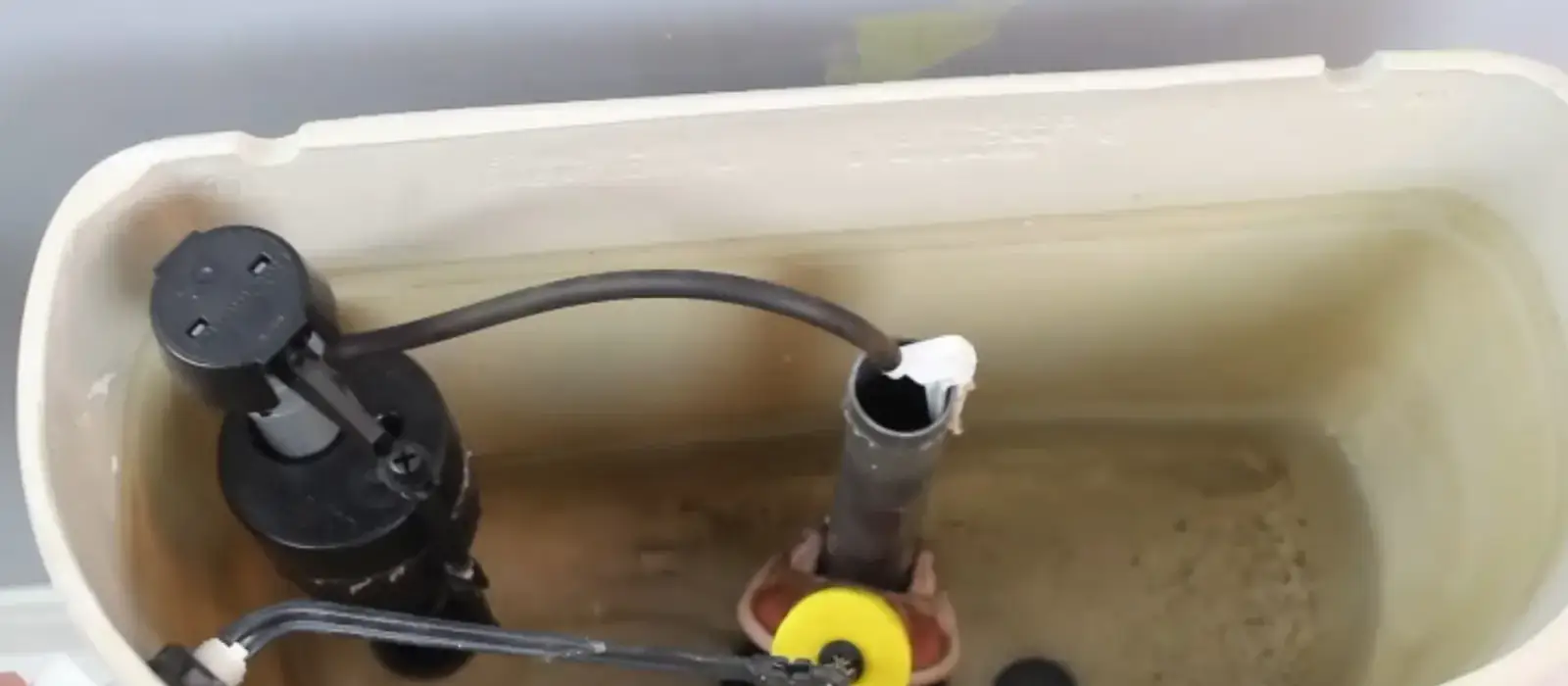
How the tank connects to the bowl
On a two piece toilet, the tank sits on the back of the bowl and is held by two or three bolts that pass through the tank bottom. A rubber gasket, often called a spud washer, seals the opening between the tank and the bowl so water can flow into the bowl when you flush. The supply line enters the tank through a fill valve, and a flapper in the bottom opens when you press the handle.
A tank leak can come from several spots, so find the source before you replace anything. Water at the tank bolts, around the spud washer or under the fill valve can often be fixed with a part. A crack in the porcelain cannot be fixed.
| Where it leaks | Likely cause | Fix |
|---|---|---|
| Between tank and bowl | Worn spud washer or loose bolts | Replace the gasket and bolts. |
| Around the bolts inside the tank | Rubber washers worn | Replace the bolt washers. |
| At the supply connection | Loose nut or worn washer | Tighten or replace the supply line. |
| From a hairline crack | Cracked porcelain | Replace the tank or the toilet. |
| Sweat on the outside | Condensation in humid weather | Insulated liner or a tempering valve. |
Why matching a tank to a bowl is hard
Toilet makers design each tank and bowl as a pair. The bolt spacing, the opening size and the shape of the bottom of the tank all differ between models. A tank from another brand may not fit even if it looks similar. Old models are often discontinued, which leaves you hunting for a match that no longer exists.
If the toilet is old, the cheaper path is often a new complete toilet. A new unit uses less water per flush, comes with a new seal and bolts, and removes the hunt for a matching tank. Our plumbing installation page explains how we set a new fixture.
Replace only the tank when
- The model is current and the maker sells the matching tank.
- The bowl is in good shape with no cracks or stains.
- The leak is a gasket or bolt issue that a part will fix.
Replace the whole toilet when
- The model is discontinued and no matching tank exists.
- The bowl wobbles, stains or clogs often.
- The toilet is old and uses a lot of water per flush.
- You are already remodeling the bathroom.
Steps to replace a toilet, in plain terms
Shut off and drain
Close the supply valve, flush, and sponge out the remaining water.
Disconnect and lift
Disconnect the supply line, remove the nuts, and lift the toilet straight up.
Check the flange
Inspect the floor flange for cracks or rot and fix it before setting the new toilet.
Set and seal
Place a new wax or rubber seal, set the toilet, tighten the bolts evenly and reconnect the supply.
A toilet weighs a lot, and cracked porcelain has sharp edges. If the floor feels soft near the base, there may be water damage under the toilet, and that is a job for a plumber. Overtightening bolts can crack the base, which is one of the most common do it yourself mistakes.
Before you buy a new toilet
- Measure the rough in, the distance from the wall to the center of the drain, which is often 12 inches but not always.
- Check the shape, round or elongated, against the space.
- Check the height, standard or comfort height.
- Look at the flush rating and the water use per flush.
- Confirm the supply valve works and the supply line is in good shape.
- Consider a new seal and bolt kit, which cost little.
Mistakes that cause leaks after a swap
Reusing an old wax ring, overtightening the bolts and setting the toilet on an uneven floor are the usual causes. Tighten each bolt a little at a time, alternating sides, until the toilet is snug and does not rock. Stop there. Extra force cracks the porcelain.
Howell note: older homes and septic systems
Howell Township covers about 61 square miles, and homes range from older houses to newer ones. A toilet that has run for years may have left moisture around the floor flange, so look for soft spots, staining or a musty smell before you set a new fixture. If a flange is cracked or rotted, it should be repaired first.
Some Howell neighborhoods use septic systems, as a 2015 report on the Freewood Acres area near Route 9 described. Septic homes benefit from toilets that use less water per flush because less water reaches the tank. If you have questions about your system, ask your septic professional. For a clog that does not clear, see our toilet repair page, and for towns nearby such as Lakewood, our crews work the same way.
Sources
The EPA's WaterSense program notes that a worn flapper can silently leak thousands of gallons a year. Toilet installation follows New Jersey adopted the 2021 National Standard Plumbing Code as its plumbing subcode in N.J.A.C. 5:23-3.15.
Rather have a plumber look at it?
Call the Howell line, any hour, and describe what you see.
Questions about this topic
Yes, but the tank must match the bowl. If the model is old or discontinued, replacing the whole toilet is often easier.
Most take an hour or two when the flange and floor are in good shape.
It is the ring on the floor that anchors the toilet to the drain. A cracked or rotted flange causes rocking and leaks and should be repaired first.
A like for like replacement usually does not, but moving the toilet or changing the drain may. Ask the township Construction Office to be sure.
The floor may be uneven, or the bolts may be uneven. Shims or a flange fix usually solves it.