Is it the element or something else
Lukewarm water is the classic symptom of a failed lower element, because the upper element heats only the top of the tank. No hot water at all can mean a failed upper element, a tripped high limit switch, a bad thermostat or a tripped breaker. Always check the simple things before you open the panel.
| Symptom | Likely cause | Next step |
|---|---|---|
| No hot water at all | Tripped breaker, tripped high limit or failed upper element | Check breaker, press the reset button, test the element. |
| Lukewarm water | Failed lower element or thermostat | Test the lower element. |
| Hot water runs out fast | Sediment, failed lower element or undersized tank | Flush the tank and test the elements. |
| Breaker trips repeatedly | Shorted element or wiring fault | Stop and call a plumber or electrician. |
| Rumbling or popping | Sediment on the elements | Flush and descale the tank. |
Safety comes first
An electric water heater runs on 240 volt power. Turn off the breaker for the heater, then confirm with a tester that the power is off at the heater before you touch any wire. If you are not comfortable with that, stop and call us. A shock hazard is not worth the savings.
Testing an element
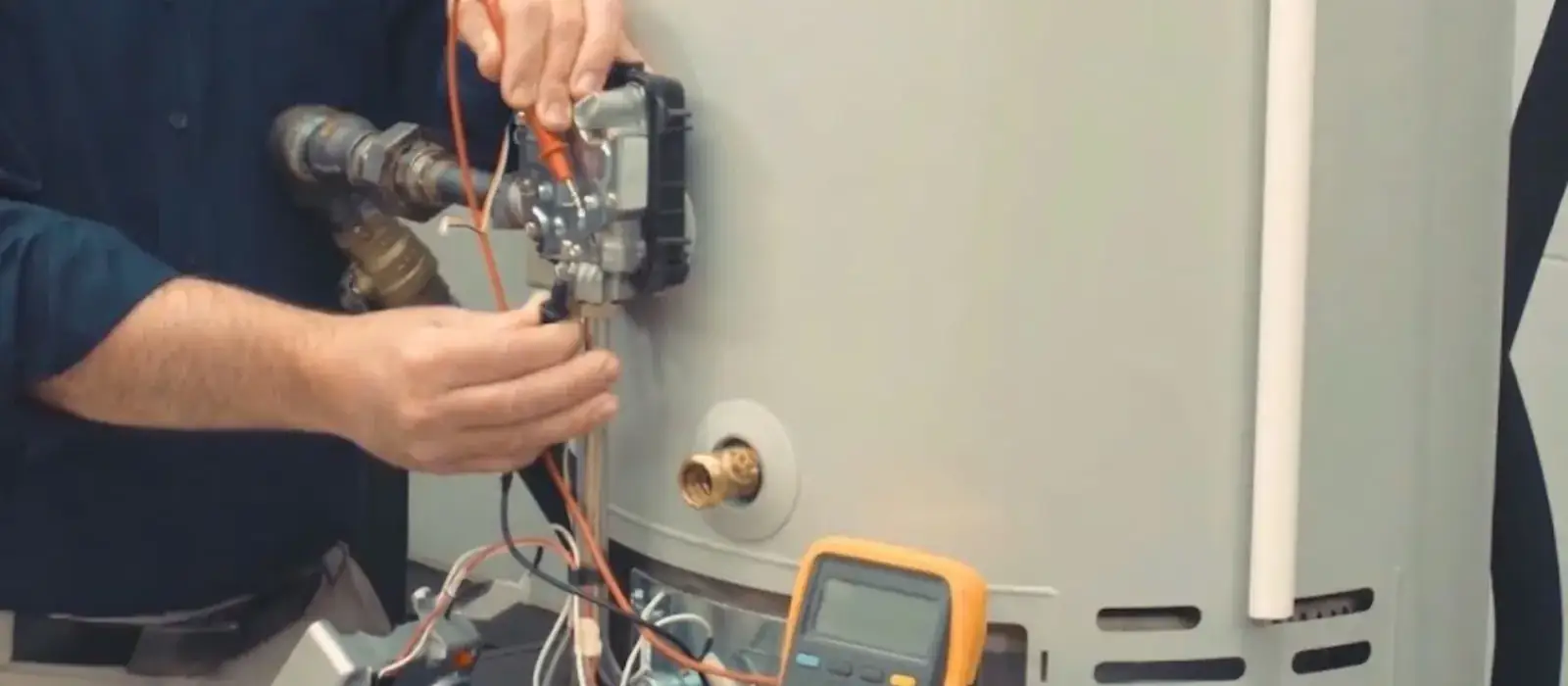
With the power off, remove the access panel and the insulation, and take off the plastic cover. Disconnect the wires from one element. A multimeter set to ohms should read a low resistance, often in the range of 10 to 16 ohms for a typical household element. An open reading means the element has failed. A reading from the element to the metal tank means it has shorted.
Replacing an element step by step
Power off and drain
Turn off the breaker, shut the cold supply, open a hot tap and drain the tank below the element level.
Remove the old element
Take off the wires, then use an element wrench to unscrew it. A stuck element may need penetrating oil and patience.
Clean the area
Remove the old gasket and scrape the opening, and rinse out the sediment you see.
Install and refill
Fit the new element with a new gasket, reconnect the wires, close the drain, refill the tank and open a hot tap until water flows with no air before you turn the breaker on.
Never turn the power back on before the tank is full. A dry element burns out in seconds. This is the most common mistake we see, and it costs a new element and sometimes a new thermostat as well.
Buy the right part
- Match the wattage and voltage printed on the heater data plate.
- Check the element style, screw in or bolt in.
- Buy a new gasket if the element does not include one.
- Check whether your heater has one element or two.
- Consider replacing both elements if one is old.
- Pick up an element wrench from a hardware store.
When the tank is the problem
If the tank is old, rusted at the base or leaking at the bottom, a new element will not save it. A tank that has already lasted around a decade rarely justifies a part and an afternoon. Read about our water heater replacement work to see how that decision usually goes. If you want a professional to handle it, our water heater repair team can diagnose it and give a clear price.
Test the heater after the repair
After the tank is full and the breaker is on, wait about an hour and check the water at a hot tap.
Feel the upper and lower sections of the tank through the access panels without touching any wire. Listen for dripping or hissing. If hot water returns and the breaker holds, the repair worked. If the water stays cold, the thermostat or the high limit switch may be the cause, and the element may not be the only part that failed.
Do not keep resetting a tripping breaker. Repeated trips mean a fault that needs a closer look, and our team can find it quickly.
Safety is the last point. Never test a live element with the power on, never bypass a limit switch and never leave the access panel off. These parts exist to prevent overheating and fire, and a repair that removes a safeguard is not a repair.
Howell note: why scale kills elements here
New Jersey American Water's 2025 water quality report for its Coastal North system lists Howell as a distribution sampling location and shows total hardness of 72 to 140 mg/L. Hardness at that level leaves a crust on a heating element over time, and a crusted element runs hotter, wears faster and burns out sooner.
A yearly tank flush slows that buildup. If your water comes from a private well, a test will show hardness and iron, and a softener or filter may be worth asking about. If you want help, our crews also work in Lakewood and nearby towns on the same basis.
Sources
Electric heater wiring falls under the National Electrical Code, NEC, and the heater maker's instructions set the element wattage and the safe steps. Plumbing connections follow New Jersey adopted the 2021 National Standard Plumbing Code as its plumbing subcode in N.J.A.C. 5:23-3.15.
Rather have a plumber look at it?
Call the Howell line, any hour, and describe what you see.
Questions about this topic
Lukewarm water points to the lower element, and no hot water points to the upper element or a tripped limit switch. A multimeter test confirms it.
Yes, but if the other is the same age it may fail soon after. Many people replace both.
Many last several years, and hard water can shorten that. A tank that is flushed regularly tends to keep its elements longer.
A shorted element, a loose wire or a wiring fault can cause it. Turn the power off and call a plumber or an electrician.
The element type is the same. Hard or iron rich well water can wear it faster, so test your water and flush the tank yearly.