Sewer or septic comes first
A disposal sends ground food into the drain. On a public sewer, the solids travel to a treatment plant. On a septic system, they land in the tank, where they add to the sludge and the scum layer and may mean more frequent pumping. Some septic professionals advise against disposals, and some systems tolerate them with careful use.
If you are not sure which system serves your house, check your records or ask the township. If it is septic, ask your septic professional before you install anything.
Choosing the right disposal
| Feature | Why it matters |
|---|---|
| Horsepower | More power grinds tougher scraps and jams less. |
| Feed type | Continuous feed uses a wall switch. Batch feed uses the stopper as the switch. |
| Grinding stages | More stages give a finer grind and less clogging. |
| Noise insulation | Matters in an open kitchen. |
| Corrosion protection | Stainless parts and coated housings last longer. |
| Mount type | Quick lock mounts ease installation and replacement. |
Installation steps in plain terms
Power off
Shut the breaker and confirm with a tester, since disposals run on household current.
Mount the flange
Seat the sink flange on plumber putty and attach the mounting ring from below.
Hang the unit
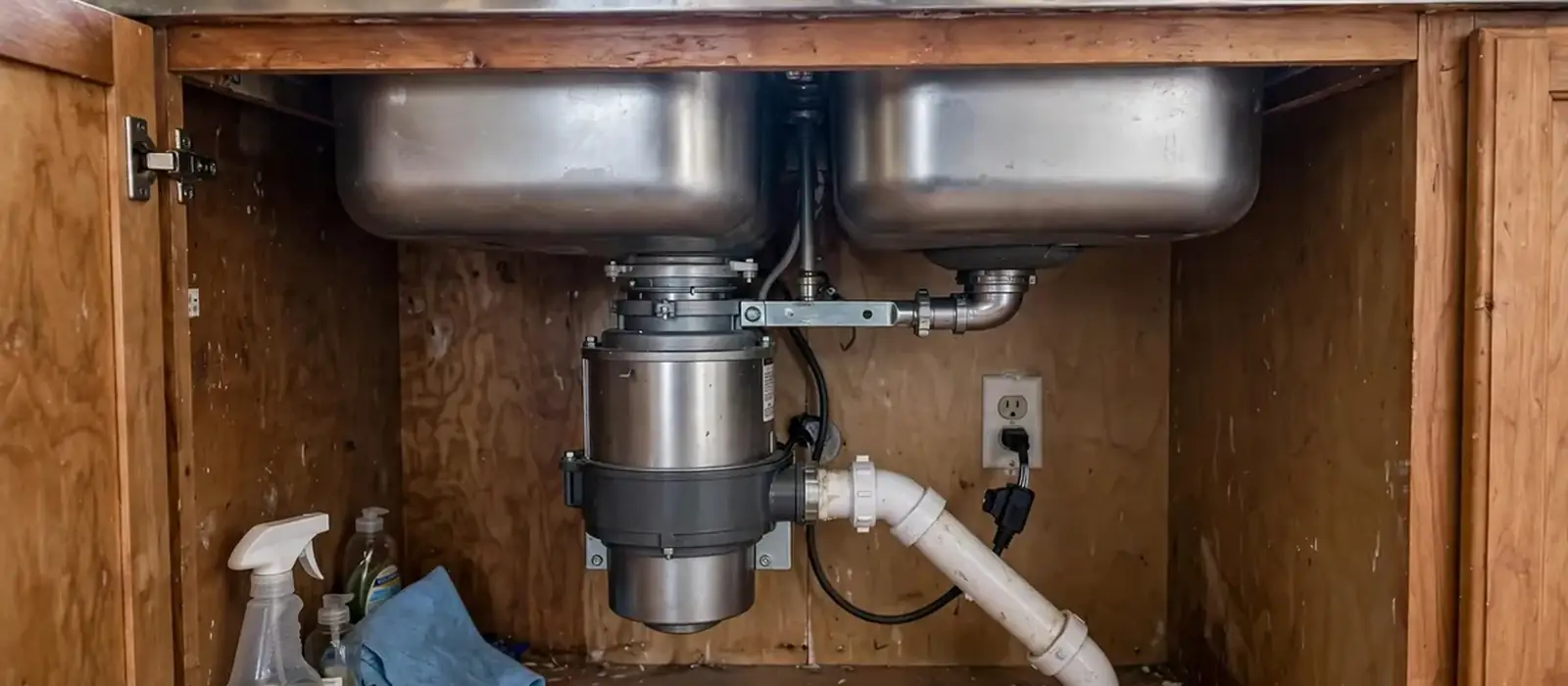
Lock the disposal onto the ring and rotate it so the drain outlet lines up with the trap.
Connect and test
Attach the drain, the dishwasher hose if any, and the power, then run water and check every joint.
If your dishwasher drains through the disposal, you must knock out the plug inside the inlet. Skipping that step causes a dishwasher that will not drain, and it is a common mistake. Our garbage disposal repair page covers jams and leaks, and our plumbing installation page explains how we handle fixture swaps.
Electrical power and the switch
Many disposals plug into an outlet under the sink, and others are hard wired. A wall switch controls a continuous feed unit. If there is no switch or outlet, an electrician needs to add one. Keep electricity safe by ensuring the outlet is protected as required and that the cord is not touching water. When in doubt, bring in a licensed electrician for the wiring.
Habits that keep a disposal working
Run cold water before, during and after use. Feed scraps in gradually. Avoid grease, pasta, rice, potato peels, celery and bones. Grind a few ice cubes now and then to clear residue, and never use chemical drain cleaners in a unit that you may have to reach into.
Signs a disposal install needs a plumber
- The sink is a different shape or has a shallow bowl.
- The drain pipe under the sink is corroded or loose.
- You need a new electrical outlet or switch.
- The existing trap does not line up with the outlet.
- The dishwasher is new and the knockout is not done.
- The sink has had leaks before.
Dishwasher connection and air gap
A dishwasher drain hose often runs to the disposal inlet or to a fitting on the tailpiece. Many layouts use a high loop, which means the hose rises under the counter before it drops to the drain, so dirty water cannot flow back into the dishwasher. Some areas call for an air gap on the countertop instead. If your dishwasher smells or fills with gray water, the hose routing is the first thing to check.
Leaks after a new install
The usual causes are a flange that was not tightened evenly, putty that was squeezed out on one side, a reversed washer on a slip joint or a hose clamp that is too loose. Run water into the sink for a minute and wipe every joint with a dry paper towel. Tighten, then test again. A leak from the housing itself means a defective unit and a return to the seller.
If the leak is at the drain connection under the sink, check the trap and the tailpiece before you blame the disposal.
Run the disposal with cold water for a few seconds after the test so you hear it spin freely. A grinding or rattling sound with nothing in the chamber suggests a stray piece of the packing or a loose part, and it is better to find that now than after the first load of scraps.
Howell note: sewer service varies by neighborhood
Howell Township covers about 61 square miles, and sewer service differs from one area to the next. New Jersey American Water states that it operates the Adelphia Wastewater Collection System in Howell Township, which serves about 4,100 accounts and about 27 miles of gravity sewer main, with flow going to the Howell wastewater system and the Ocean County Utilities Authority for treatment. Other areas rely on private septic systems.
That split is why the first question we ask on a disposal call is where your drain goes. A house on a municipal sewer can usually take a disposal without trouble, while a house on septic may need advice first. Customers in Lakewood and other nearby towns ask the same question, and our service area page lists where we work.
Sources
Wiring a disposal falls under the National Electrical Code, NEC. Septic systems are covered by the state's standards for individual subsurface sewage disposal systems, N.J.A.C. 7:9A. Drain work follows the state plumbing subcode, N.J.A.C. 5:23-3.15.
Rather have a plumber look at it?
Call the Howell line, any hour, and describe what you see.
Questions about this topic
It adds solids to the tank and can mean more frequent pumping. Ask your septic professional before installing one.
A half to three quarter horsepower unit suits most households. A larger family or heavy cooking may justify more power.
The dishwasher inlet plug inside the disposal may still be in place. It must be knocked out.
Only if the wiring, switch or outlet is missing or unsafe. Many installations use an existing outlet.
Check your records, look for a cleanout or a septic cover in the yard, or ask the township. If you are unsure, tell us before the install.