
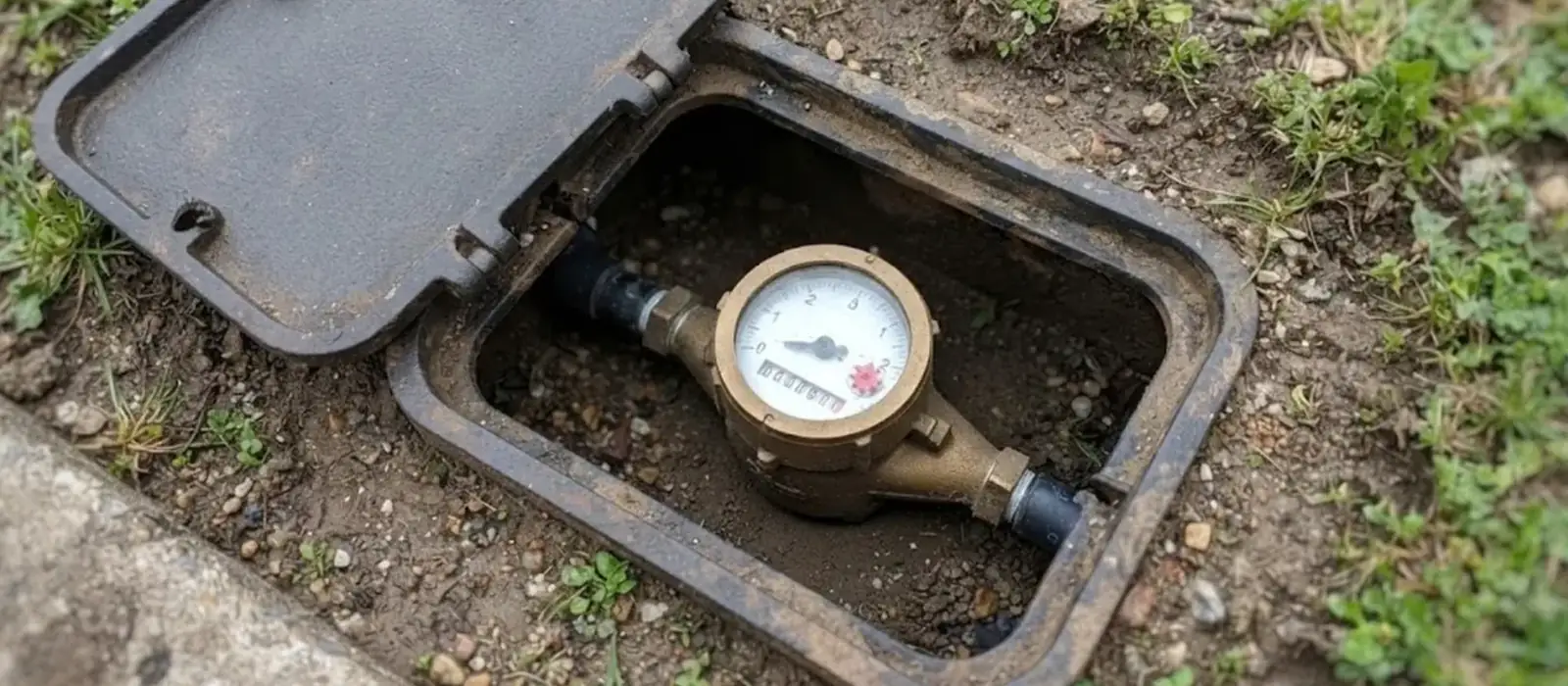
Step 1: the meter test
The water meter is the best leak detector you have. Turn off every tap and appliance in the house, including the ice maker and the irrigation system. Find the meter, usually in the basement, a utility room or a ground box near the street, and read the dial or look at the small leak indicator.
Wait thirty minutes without using water, then read it again. If the numbers moved or the indicator spins, water is leaving the pipes somewhere. If the meter did not move, you may still have a small leak that shows only when water is under pressure for longer.
Shut off all water use
No taps, no washer, no dishwasher, no irrigation.
Read the meter
Note every digit or the dial position, or take a photo.
Wait
Leave the water off for at least thirty minutes, or longer if you can.
Read again
Any change means a leak exists on the house side of the meter.
Step 2: is it inside or outside the house
Close the main shutoff valve inside the house and look at the meter again. If the meter keeps moving with the main closed, the leak is between the meter and the valve, which usually means the underground service line or the piping at the meter. If the meter stops, the leak is inside the house or in a branch line beyond the valve.
Step 3: check the usual suspects
| Spot | Test | Sign of a leak |
|---|---|---|
| Toilet tank | Add food coloring to the tank and wait 15 minutes | Color in the bowl without flushing. |
| Faucets and showerheads | Look and listen with every fixture closed | Drips, hiss or stains. |
| Water heater | Check the base, relief valve and pipes | Wet floor, rust, mineral crust. |
| Washing machine hoses | Check connections and the supply valves | Bulging hose, drip at the valve. |
| Irrigation system | Shut off the zone valves and recheck the meter | Meter stops when irrigation is off. |
| Outdoor spigot | Look at the spigot and the wall behind it | Water inside the wall or under the spigot. |
Other signs to write down
- Water stains or bubbling paint on walls or ceilings.
- A musty smell in a closet or cabinet.
- Warped floors or baseboards.
- A sudden drop in water pressure.
- A wet spot or soft ground in the yard.
- A bill that rises with no change in use.
Step 4: the ice and refrigerator line
A refrigerator water line can leak behind the unit for weeks. Pull the refrigerator out carefully, look at the connection at the wall and the line to the back of the unit. A slow drip at a compression fitting is a common source. Replace worn lines and shut off the valve if you find a leak.
When to stop and call a plumber
If the meter moves and the quick checks do not explain it, a plumber should take over. A hidden leak behind a wall, under a floor or in the ground needs acoustic listening, thermal imaging or a pressure test to pinpoint it. Our leak detection page explains how those tools work. If a pipe has already split, read about burst pipe repair.
Do not cut into drywall to look for a leak without a plan. Opening the wrong spot adds repair work and may not find the source. Also avoid chemical leak sealers poured into the system, since they can clog valves and fixtures.
Keep a simple leak log
If you suspect a slow leak, write down the meter reading at the same time every evening and every morning for three days, with a note of any water used. A pattern of readings that climb overnight when no water was used is strong evidence of a leak, and the log gives a plumber a head start on where to look. Photographs of stains with the date make the story clearer still.
Howell note: your meter and your water source
New Jersey American Water supplies public water in part of Howell Township, including through its Coastal North system, and its Yellowbrook Water Treatment Plant sits inside the township. If your house is on that system, the meter in your basement or at the curb is the tool in this guide. Reading it at night, when no one uses water, is the most reliable test.
Many Howell homes use private wells, and those have no utility meter. On a well, a leak shows as a pump that cycles too often, a drop in pressure or a jump in electric use. Tell us which you have when you call. Our crews also help homeowners in Lakewood, and our service area page lists nearby towns.
Sources
According to the EPA's WaterSense program, the average household's leaks can waste more than 9,300 gallons a year, and a faucet dripping once per second can waste more than 3,000 gallons a year. The EPA suggests checking the meter over a two hour period with no water use.
Rather have a plumber look at it?
Call the Howell line, any hour, and describe what you see.
Questions about this topic
Warm spots on the floor, the sound of water, a high bill and a moving meter with every tap off are the signs. Slab leaks are less common in New Jersey than in southern states, and most homes here have basements or crawlspaces.
Often it does. A bill that rises over several weeks with no change in habits is a common clue. Check the meter before assuming the usage is normal.
Sometimes, at a visible fixture. Hidden leaks in walls, floors or the ground need acoustic tools that pick up faint sounds through materials.
The leak may be small or intermittent, or the water may be condensation or a drain leak. A plumber can test the pipes under pressure and check the drains.
Watch the pressure tank and pump. A pump that cycles often or runs with nothing on suggests a leak. A plumber can isolate the sections of the line to find it.