
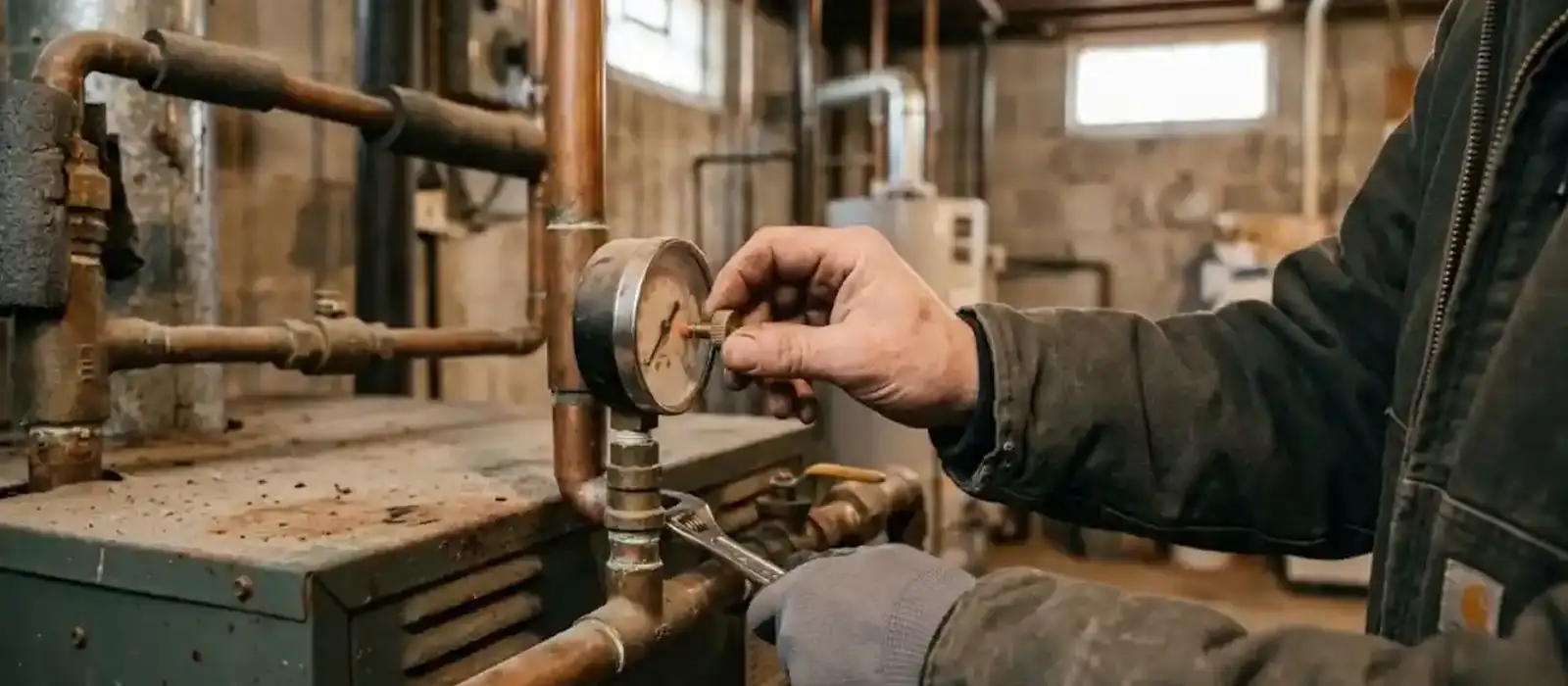
What to do first
Immediate steps
- Turn the boiler off at its switch and, if you can, at the breaker.
- Shut the boiler water supply valve if water is leaking.
- Leave the house and call the gas utility or 911 if you smell gas.
- Do not use the boiler again until a plumber inspects it.
- Keep carbon monoxide alarms working near sleeping areas.
- Take photos of the leak for your insurance agent.
A boiler holds hot water or steam under pressure. A leak that starts small can grow, and a sudden failure can release hot water. Do not try to patch a crack with epoxy or sealants, because they do not hold on a part that heats and cools every day.
Where a boiler can crack
| Where | What it is | Typical outcome |
|---|---|---|
| Cast iron section | Thermal shock or age | Often replacement, sometimes a section swap on older units. |
| Heat exchanger (steel or aluminum) | Corrosion, scale or overheating | Replacement of the exchanger or the boiler. |
| Piping or fitting near the boiler | Corrosion or a loose joint | Repairable. |
| Expansion tank | Waterlogged or corroded | Replace the tank. |
| Relief valve discharge | Not a crack, but a sign of overpressure | Diagnose the cause. |
A leak at a valve, a pump flange or a pipe fitting is repairable. A leak from the boiler body or the heat exchanger is not a small repair. Our boiler repair page explains how we find the source and decide.
Why it happens
Cast iron boilers can crack from thermal shock, which happens when cold water hits a very hot section. Low water, a failed pump or a closed valve can cause it. Steel and aluminum exchangers corrode over time, and scale from hard water can cause hot spots that stress the metal. An old boiler has simply been through more cycles.
Repair or replace
Repair may be possible when
- The leak is at a fitting, valve or pump flange.
- The boiler is relatively new and under warranty.
- The cracked part is a replaceable section on a serviceable cast iron unit.
- The expansion tank, not the boiler, has failed.
Replace the boiler when
- The heat exchanger or the boiler body is cracked.
- The boiler is more than about 20 years old.
- Parts are no longer made.
- Repairs are adding up each season.
We give you the numbers, including a clear price for repair and for a new boiler. We also explain what the replacement entails, such as new venting, a new expansion tank, new valves and air elimination, which fall under our plumbing installation work. If hot water is the only problem, see water heater repair.
Carbon monoxide and combustion
A cracked exchanger on a gas or oil boiler can leak combustion gases into the house. Carbon monoxide has no smell. Working alarms near sleeping areas are your protection. If an alarm sounds, leave the house and call 911 and the gas utility. Do not go back in to find the cause.
Steam and hot water boilers differ
A steam boiler holds a lower pressure and heats radiators with steam. A hot water boiler pushes heated water through baseboards or radiators under moderate pressure.
Both can crack, but the signs differ. A steam boiler that has run low on water may crack a section and lose water quickly through the bottom. A hot water boiler may show a pressure drop and a steady drip at the base. Tell the plumber which type you have and what the gauges read. Photos of the boiler nameplate and the gauges help us bring the right parts and give you a more accurate first answer on the phone.
If the boiler is shut down and the house is cold, protect the plumbing. Open cabinet doors under sinks on exterior walls, keep a trickle of water moving at the most exposed taps in a hard freeze and use safe space heaters only as the maker directs. A frozen pipe on top of a failed boiler turns one repair into two.
What to document for your insurance agent
Photograph the boiler, the leak and the gauge readings before anyone touches them. Note the date you first saw the problem and the date you shut the system down. Keep any parts that are removed, and keep the written findings from the plumber. Policies treat sudden damage differently from wear, and the record helps your agent tell which one applies. We give you a written summary of what we found.
Howell note: fuel, utilities and permits
Howell homes heat with a mix of fuels and systems, so tell the plumber whether your boiler runs on natural gas, oil or propane. Gas and oil units have different burners, controls and venting, and the person who services the burner may differ from the person who replaces the boiler.
A boiler replacement can involve a permit. The township Construction Office, at the municipal building on Preventorium Road, can tell you what applies. If your boiler fails during a cold snap, call early, because parts and crews get busy. We also help Lakewood homeowners with no heat calls, and our service area page lists nearby towns.
Sources
According to the CDC, you should install battery operated or battery backup carbon monoxide detectors near every sleeping area and have heating systems serviced by a qualified technician every year. The CDC suggests replacing detectors every five years or per the maker.
Rather have a plumber look at it?
Call the Howell line, any hour, and describe what you see.
Questions about this topic
A crack in the boiler body or heat exchanger usually means replacement. A leak at a valve, fitting or pump can be repaired.
It can be. Hot water, pressure and, on gas or oil units, combustion gases are risks. Turn it off and call a plumber.
Many last around 15 to 25 years with good care, depending on type and water quality.
Policies differ. Wear is usually not covered, but sudden damage may be. Ask your agent and keep photos.
A slow leak, a failed expansion tank or a faulty fill valve may be the cause. Turn the boiler off if water is leaking and have it inspected.