Why homeowners replace copper
Copper is a good pipe, and many copper systems last for decades. It can fail in some conditions. Pinhole leaks from pitting, leaks at old solder joints and corrosion near fittings are the usual reasons. After the second or third leak in a short time, repeated repairs start to cost more than a replacement.
Signs a copper system is wearing out
- Repeated pinhole leaks on different runs.
- Green or blue stains on pipes and fittings.
- Blue green water or a metallic taste.
- Dropping pressure at upper floors.
- Water stains on ceilings under pipe runs.
- Previous repairs with many patches.
PEX compared with copper
| Feature | PEX | Copper |
|---|---|---|
| Flexibility | Bends around corners, fewer fittings | Rigid, needs many fittings. |
| Install time | Usually faster | Slower. |
| Freeze tolerance | Handles expansion better | Can split when frozen. |
| Sunlight | Must be shielded from UV | No issue. |
| Heat sources | Keep clear of flues and heaters | Handles heat well. |
| Water chemistry | Resists pitting | Can pit in aggressive water. |
| Track record | Newer, widely used | Very long. |
Neither material is perfect. PEX has a shorter track record, it needs support and protection from sunlight, and it needs proper connections and tools. Copper costs more and takes longer to install. We tell you the trade offs and pick based on the house and the water, not on what is cheapest for us. Our repiping page covers whole house and partial options in more detail.
How the repipe runs
Plan the routes
We walk the house, choose where the main and the branches will run and decide where access openings will be.
Cut access
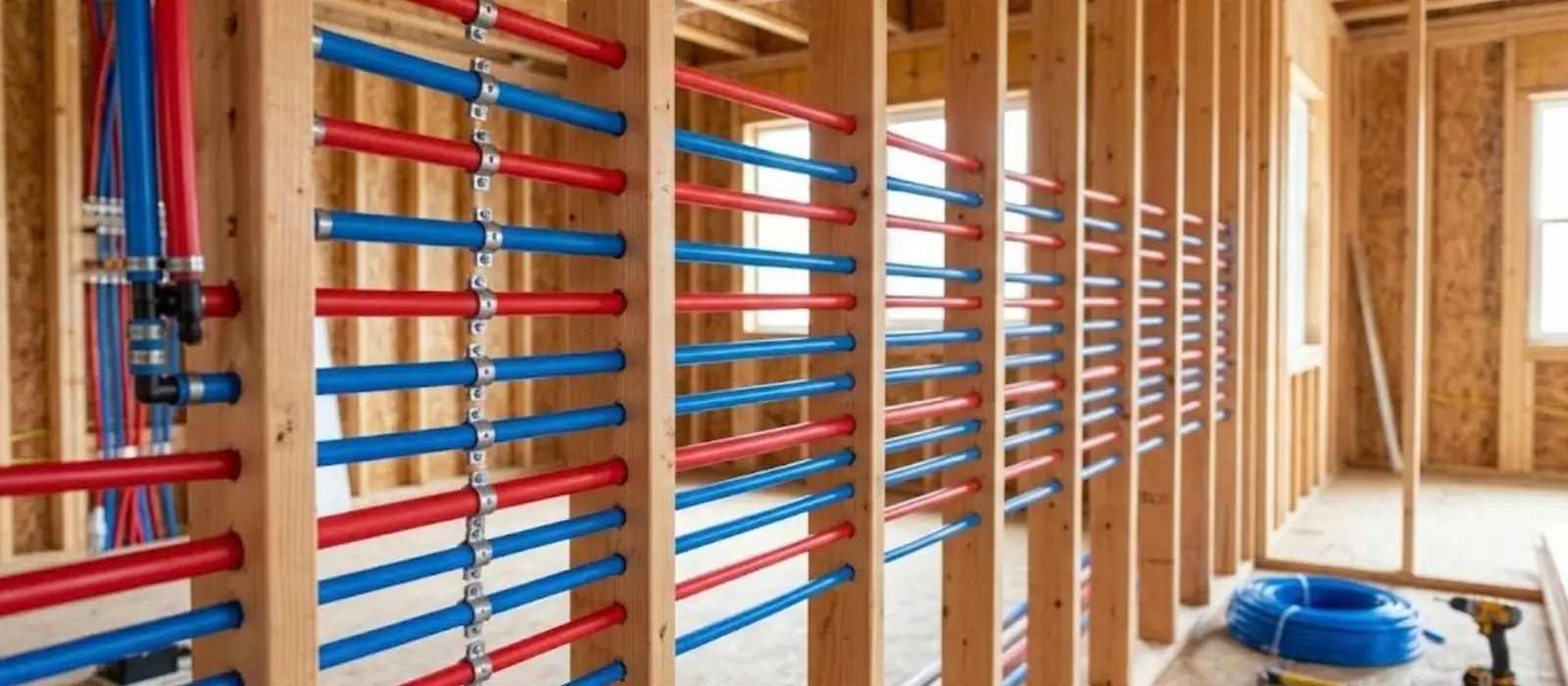
We open small sections in walls or ceilings only where needed. PEX allows fishing lines through framing in many spots.
Run new lines
We install the main, the manifold or tees, and each branch, then connect fixtures and the water heater.
Test and restore
We pressure test the system, remove the old copper where practical and discuss drywall repair.
Water is off for part of each day, and we plan around that. A partial repipe of one problem run takes less time than a whole house job. If the problem is a single section, a partial job may be enough.
What to ask before you sign
Questions for any repipe contractor
- Which PEX type and which fitting system will be used.
- Where will access openings be, and who repairs the drywall.
- How long will the water be off each day.
- Is a permit included, and who schedules the inspection.
- What happens to the old copper pipe.
- Is the main shutoff replaced as part of the job.
Pressure, noise and hot water after the switch
Most homeowners notice little change in pressure after a properly sized PEX repipe, and some notice better flow where old, corroded copper had narrowed. Water hammer, the knock you hear when a valve closes quickly, can sometimes improve because PEX flexes slightly, though a missing air chamber or a high house pressure can still cause it. We check the pressure at the main during the job and tell you if a regulator is worth adding.
Hot water deserves a mention. PEX is not a heat source, and it needs the right connections at the water heater, usually a short run of metal pipe or approved fittings between the tank and the plastic. Keep PEX away from flues, recessed lights and other heat sources. We follow the maker instructions on clearances and supports so the new lines do not sag or rub.
After the work: walls, ceilings and records
Repiping leaves small access openings in drywall or plaster. Some contractors patch them, and some hand the job to a drywall trade. Ask which applies and who pays. Keep the permit paperwork, the final inspection sign off and a note of the PEX brand and fitting system, since you may need them when you sell the house or call your insurer.
Howell note: permits and water quality
Repiping generally needs a permit. In Howell, the Construction Office and its plumbing subcode official work from the municipal building on Preventorium Road and can tell you what applies, including which materials the inspector accepts for your job. Ask before you sign, and make sure your contractor handles the permit.
New Jersey American Water's 2025 Coastal North report, which lists Howell as a distribution sampling location, shows total hardness of 72 to 140 mg/L. Water of that kind is not unusually aggressive to copper, which means a failed system may reflect age, installation quality or local conditions at your house. A well customer should test the water. We also work in Lakewood and nearby towns.
If you only have one bad section, ask about a partial job. If the leak is not yet found, start with leak detection, and read how our burst pipe repair team handles sudden failures.
Sources
PEX tubing for water supply is made to ASTM F876, and parts that touch drinking water carry the NSF/ANSI 61 mark. The state plumbing subcode adopts the 2021 National Standard Plumbing Code under N.J.A.C. 5:23-3.15.
Rather have a plumber look at it?
Call the Howell line, any hour, and describe what you see.
Questions about this topic
PEX is widely used and has a good record, and copper has a longer one. Both can last for decades when installed well. The right choice depends on your house and your water.
A partial repipe can take a day or two, and a whole house job often takes several days.
Properly sized PEX should keep good pressure. Larger or longer runs and the right fittings matter.
Usually yes. Ask the township Construction Office, and make sure your plumber handles it.
Yes. A partial repipe that replaces a failing run costs less, and it works when the rest of the pipe is in good shape.